
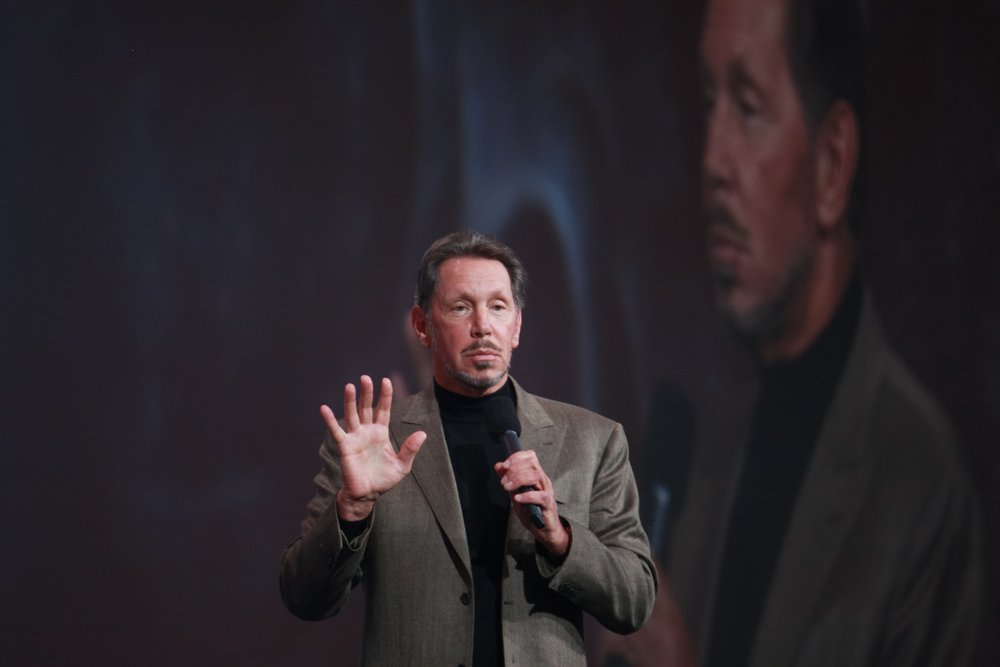
Larry Ellison used his stage at Oracle AI World in Las Vegas this week to make a prediction and a policy proposal in the same breath. The prediction: AI and robotics will make people "healthier and wealthier" within a generation. The proposal: governments should stop taxing human labour and instead capture the value that machines add, through a mechanism he compared to VAT, and use that pool to pay citizens a universal income.
He was candid that none of this arrives soon. His own horizon was more than a decade, and he made the outcome conditional on getting taxation and computing systems right, not on the technology alone.
The rebuttal arrived before the speech
The International Labour Organisation published its view in May. It rejects a government-funded universal basic income as the answer to AI and calls two industry claims weak: that AI will wreck labour markets, and that productivity gains would make cash transfers harmless to prices. Its core argument is about supply. Raising the number on a cheque achieves little if housing, healthcare, quality food and care are not produced in greater volume at stable prices, and AI lifts output in those sectors only partially and unevenly.
Both positions are forecasts. Neither is a plan a business can act on. So we asked a narrower question: what does this debate look like from a finance office in Dubai?
The UAE does not need to switch its tax base
Ellison's proposal assumes an economy that funds itself by taxing wages. The UAE does not. There is no tax on personal income. VAT at 5% has applied since 2018, Corporate Tax at 9% since 2023, and e-invoicing is now being phased in. The state here is already funded by consumption and corporate profit rather than payroll.
That changes the live question. It is not whether the tax base should move toward machine-added value. It is how fast the Federal Tax Authority's data, invoice by invoice and return by return, will let it see that value. A business that keeps clean Corporate Tax computations and e-invoicing-ready records is, whether it intends to or not, building the trail any future levy would run on.
Three questions for UAE boards this quarter
- What share of our margin comes from automation rather than people? Most companies cannot answer. It is a management-accounts change: tag automation-driven savings and revenue as their own lines. Firms with that number will negotiate with regulators; the rest will be told.
- Are e-invoicing readiness and Corporate Tax compliance one project or two? They should be one. The same data serves both, and the same gaps hurt both.
- Where has output per employee not moved in two years? The ILO's supply point is a commercial one. Housing, healthcare, food and care are where UAE operators are investing and where AI adoption still trails finance and logistics. The lag is the margin.
Universal income may or may not come. Productivity accounting is coming either way, and it will be read from your books.
Valunxt Consulting benchmarks productivity and automation value for UAE businesses. Speak to a Specialist.
Source: The National, "AI will bring in universal income and everyone will get wealthier, Oracle's Larry Ellison says", Aarti Nagraj, 28 October 2026.